The Little Girl Walked Up to a Group of Bikers Outside Her Brother’s Funeral and Asked a Simple Question — “Can You Carry Him? He Can’t Walk Tomorrow,” She Said Softly, But the Moment Hundreds of Motorcycles Lined the Cemetery the Next Morning, the Entire Town Fell Silent at What They Had Done
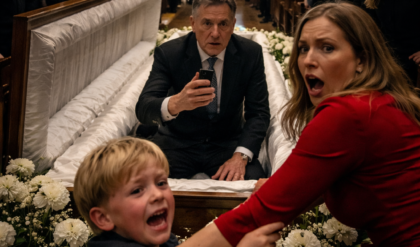
The first thing I noticed wasn’t the arguing—it was the way the room seemed to shrink around it, as if grief itself had edges and those edges were pressing inward, forcing every harsh word to echo louder than it should have under the soft, practiced lighting of Holloway & Sons Funeral Home, where everything was designed to make loss feel orderly even when the people inside it were unraveling in ways no arrangement of flowers could soften.
The small white casket sat at the center of that unraveling, impossibly still, impossibly quiet, a contradiction in satin and polished wood that refused to match the memory of a boy who had once filled every space he entered with motion, with noise, with questions that never waited for permission to be asked.
Sarah Bennett stood across from her ex-husband with a kind of stillness that didn’t come from calm but from exhaustion so deep it had burned through tears and landed somewhere colder, somewhere sharper, and when he spoke again—about cost, about appearances, about things that belonged nowhere near that room—it wasn’t just anger that rose in her chest, it was something heavier, something final.
“You don’t get to measure him like that,” she said, her voice low but cutting through the murmurs like a blade drawn slowly across glass. “Not here. Not now.”
Dean shifted his weight, uncomfortable but unwilling to retreat, the kind of man who mistook stubbornness for strength and volume for authority. “I’m being realistic,” he replied, though even he seemed aware that the word didn’t belong in the presence of a child’s casket.
From the side, Sarah’s younger sister, Alina, stepped closer, her hand resting protectively on the shoulder of the smallest figure in the room—six-year-old Nora, who stood in an oversized black coat, her fingers curled around the sleeve as if holding on to something she didn’t fully understand but refused to let go of.
“Enough,” Alina said, her tone steady in a way that suggested she had been holding the family together in quiet ways long before this moment demanded it out loud.
But the damage had already been done.
Because children don’t need full explanations to understand when something is wrong; they read tone, posture, silence, and Nora had been watching everything with wide, unblinking eyes that seemed to absorb more than any adult in the room realized.
“Why is everyone mad at him?” she asked suddenly, her voice small but clear enough to still the room in a way no adult command had managed.
No one answered immediately.
Because there was no answer that didn’t sound hollow.
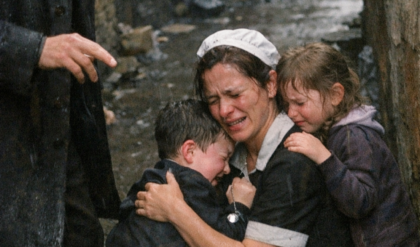
Sarah dropped to her knees in front of her daughter, hands trembling as they reached for Nora’s coat sleeves. “No one is mad at him,” she said, though the lie felt fragile even as she spoke it. “People just… don’t know how to be quiet when they should.”
Nora looked past her, toward the casket, toward the stillness that made no sense to a child who had only ever known her brother as movement, as laughter, as the boy who raced her down the hallway and let her win just often enough to keep her trying.

“Who’s going to carry him?” she asked.
The question landed heavier than anything that had come before it.
Because that was the truth beneath all the arguments, all the tension no one wanted to name—the absence of hands willing to do the one thing that mattered most tomorrow.
Dean looked away.
“I can’t,” he muttered.
Sarah stood slowly, something in her expression shifting from grief to resolve, the kind that doesn’t announce itself loudly but settles into place like a decision that will not be undone.
“Then I will find someone who can,” she said.
No one challenged her.
Not because they agreed, but because they didn’t know how to argue with someone who had nothing left to lose.
Later, when the room had thinned and the murmurs had moved into quieter corners, Nora slipped away.
No one noticed at first.
Not Alina, who was speaking softly with the funeral director about timing and logistics. Not Sarah, who sat in a small office signing papers she could barely see through the blur of exhaustion. Not Dean, who had retreated to the hallway with his phone and his discomfort.
Nora moved with the quiet determination of a child who had made a promise to herself.
She walked past the rows of chairs, past the arrangements of flowers that all looked too large for someone so small, and out through the side doors where the afternoon light spilled across the parking lot in long, warm lines.
That was where she saw them.
A group of men stood near a line of motorcycles parked along the edge of the lot, their presence unmistakable even from a distance—leather vests, heavy boots, the low rumble of engines cooling after a ride, the kind of figures adults instinctively warned children about without ever fully explaining why.
One of them stood slightly apart.
Older than the rest, his beard threaded with gray, his posture relaxed but alert in the way of someone who had spent years reading the world before it could surprise him.
Nora didn’t hesitate.
She walked straight toward him.
The man noticed her halfway across the pavement, his expression shifting from casual observation to something more focused, not unkind, but careful.
“Hey there,” he said when she stopped in front of him, his voice low enough not to startle her. “You lost?”
She shook her head.
“No.”
He waited.
Because something in her face told him this wasn’t a child who had wandered by accident.
“My brother is inside,” she said, pointing back toward the building. “He can’t walk tomorrow.”
The man’s gaze followed her gesture, then returned to her, slower this time, more deliberate.
“I’m sorry to hear that,” he replied.
Nora took a small breath, the kind children take when they’re about to say something they don’t fully understand but know is important.
“Can you carry him?”
The question hung in the air, simple and impossible all at once.
The men behind him fell silent.
Because there are moments when even the loudest people recognize something sacred enough not to interrupt.
The man looked at her for a long second.
Not evaluating. Not hesitating.
Understanding.
“Yeah,” he said quietly. “I can do that.”
Nora nodded, as if the answer had been expected all along, and turned back toward the building without another word.
The man watched her go, then glanced at the others.
“Well,” one of them muttered, breaking the silence with a half-smile, “guess we’ve got a job.”
The next morning, the town woke to a sound it had never heard in that way before.
Not a single motorcycle.
Not a passing roar.
But a gathering.
Hundreds of engines, low and steady, rolling in from highways and back roads, from towns near and far, forming a procession that moved with a kind of discipline that surprised anyone who had only ever known them through rumor and assumption.
By the time Sarah arrived at the cemetery, the hillside was already lined with bikes.
Rows of chrome and black, stretching farther than she could take in at once, their riders standing beside them in quiet formation, not loud, not chaotic, but still in a way that felt intentional.
She stopped at the edge of the lot, confusion flickering across her face.
“What is this?” she asked Alina, who stood beside her, equally stunned.
Before either of them could answer, the gray-bearded man stepped forward.
He removed his gloves slowly, as if approaching something that required respect more than explanation.
“You Sarah?” he asked.
She nodded.
“I’m Victor Kane,” he said. “Your daughter came out yesterday.”
Sarah blinked, the pieces not quite fitting together yet.
“She asked me something,” he continued. “Figured I should show up with the right answer.”
Understanding dawned in stages.
Slow.
Then all at once.
“You’re here for…” she began, her voice trailing off as she looked past him, at the sheer number of men standing quietly in the morning light.
“For your boy,” Victor said simply.
The service itself passed in a kind of softened clarity.
Words were spoken.
Prayers offered.
Voices trembled and steadied and trembled again.
But what people remembered—what stayed—was the moment when six men stepped forward to lift the small white casket.
Not hurried.
Not uncertain.
Steady.
Measured.
As if they understood the weight they carried was more than physical.
Nora stood beside her mother, her small hand wrapped tightly in Sarah’s, watching with an intensity that made her seem older than her years.
“That’s him,” she whispered. “The one I asked.”
Sarah looked at Victor, then at the others, then back at her daughter.
“You asked him?” she said softly.
Nora nodded.
“You said we could ask for help.”
Sarah swallowed, emotion rising in a way she had not allowed herself to feel fully until that moment.
“I did,” she said.
The procession moved.
Engines didn’t roar.
They waited.
Silent.
Respectful.
Until the final moment, when the casket was lowered and the last words were spoken.
Then, as if on some unspoken signal, the bikes came to life.
Not in chaos.
Not in noise for the sake of noise.
But in a single, rising wave of sound that rolled across the hillside like distant thunder, deep and steady, a farewell that didn’t rely on words because it didn’t need them.
People would talk about that sound for years.
Not because it was loud.
But because of what it meant.
In the weeks that followed, things changed in ways no one had expected.
The town, which had once kept its distance from men like Victor and his brothers, found itself rethinking what it thought it knew.
The funeral home received donations from people who had never met Mason but felt compelled to help.
The school started a fund in his name, quietly ensuring that no child in that district would ever be left without support in moments that mattered.
Dean disappeared from the story the way some people do—not dramatically, not with confrontation, but with a quiet absence that spoke louder than any argument ever had.
And Nora?
She kept drawing motorcycles.
Hundreds of them.
Different shapes, different colors, always in long lines that stretched across the page.
One afternoon, weeks later, Sarah found her sitting at the kitchen table, coloring carefully within the lines of a new drawing.
“What’s this one?” Sarah asked, pulling out a chair beside her.
Nora didn’t look up right away.
“It’s the day he wasn’t alone,” she said finally.
Sarah felt something in her chest settle, not healed, not whole, but steadier than it had been.
“You did that,” she said.
Nora shook her head.
“No,” she replied. “They did.”
Sarah smiled faintly, brushing a stray curl from her daughter’s face.
“You asked,” she said. “Sometimes that’s the part people forget.”
And in a quiet way, in a town that would never quite sound the same again, that turned out to be true.