The Crowd Accused the Tattooed Man of Taking a Lost Little Girl in the Middle of a Busy Mall — “Separate Them Now,” Security Insisted as People Called the Police, But the Moment Her Real Father Came Running and She Clung to the Man Saying “He Stayed When I Was Scared,” the Entire Story Collapsed and No One Knew Where to Look
There are moments when you realize, almost too late, that what everyone around you is certain about might be the one thing that’s completely wrong, and that if you don’t step forward—not loudly, not heroically, but simply enough to interrupt the momentum of assumption—something irreversible might happen right in front of you while people convince themselves they’re doing the right thing.
That afternoon, I had no intention of becoming part of anyone else’s story.
I was sitting near the edge of the food court in a mall outside Columbus, letting my coffee cool past the point of drinkability while watching the steady rhythm of strangers passing each other without connection, each person carrying their own invisible narrative, their own reasons for being there, their own quiet urgencies that never quite touched anyone else.
It was the kind of ordinary that blends into itself—until it doesn’t.
The shift came without warning.
A chair scraped too loudly. A tray clattered to the floor. Conversations cut off mid-sentence.
You could feel it before you understood it, that sudden tightening in the air when attention gathers around something uncertain, when curiosity sharpens into suspicion without needing facts to justify it.
That’s when I saw them.
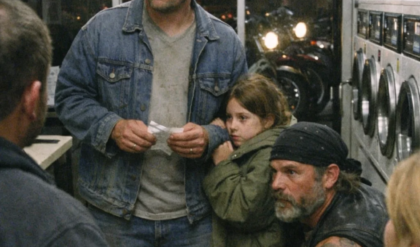
He stood near the center walkway, broad-shouldered, wearing a worn black leather vest over a gray T-shirt, his arms marked with faded tattoos that seemed less like decoration and more like history written directly into his skin. There was nothing exaggerated about him, nothing theatrical, but something in his presence made people step back instinctively, as if they had already decided what he represented before he said a single word.
Beside him stood a little girl.
She couldn’t have been older than ten, small and quiet in a loose pink hoodie that swallowed her frame, her hand resting lightly inside his, not gripping tightly, not clinging in fear, just… there, like it belonged.
That detail should have mattered more to everyone watching.
It didn’t.
Two security guards had already reached them, their movements controlled but firm, hands on his arms in a way that signaled authority without outright aggression.

“You need to come with us,” one of them said, his tone measured, professional, the kind of voice that doesn’t invite discussion.
The man didn’t resist.
Didn’t pull away.
Didn’t even look at them.
Instead, his gaze stayed fixed on the girl beside him, steady, focused, as if everything else happening around him was secondary to making sure she stayed exactly where she was.
That was the first thing that didn’t fit.
People around me had already begun constructing the story they preferred.
“That’s not his kid,” someone said behind me, not as a question but as a conclusion.
Another voice chimed in, quieter but sharper. “You can tell.”
A woman near the counter shook her head, her expression tightening with a kind of certainty that didn’t come from evidence, only from familiarity with the narrative she expected to see.
The girl’s fingers tightened slightly around the man’s hand.
Not in panic.
Not in confusion.
Just enough to signal awareness.
He noticed it immediately.
His jaw tightened, not with anger, but with restraint, the kind that comes from choosing not to escalate even when everything around you is pushing in that direction.
“I’m calling the police,” someone else announced, louder now, as if volume could turn assumption into fact.
One of the guards shifted his attention toward the girl, softening his voice as he crouched slightly.
“Hey there, sweetie,” he said, extending his hand toward her. “Why don’t you come with us for a minute?”
She took a small step back.
Not dramatic.
Not frightened.
Deliberate.
And that’s when something in my chest shifted.
Because her reaction didn’t match the story everyone else had already accepted.
I stood up before I fully understood why.
My chair scraped loudly against the tile, drawing attention I hadn’t planned on attracting.
“Wait,” I said, my voice steadier than I felt.
Both guards looked at me, irritation flickering across their faces, the kind reserved for interruptions they didn’t ask for.
“This doesn’t look right,” I added, even as a part of me questioned whether I was about to make a mistake.
The man still didn’t look at me.
Didn’t acknowledge anyone but the girl.
The crowd leaned in, their silence heavier now, expectant, as if waiting for confirmation of what they already believed.
And then the girl spoke.
Her voice was soft, but it cut through the tension with a clarity that forced people to listen.
“He told me to stay with him,” she said.
The room seemed to tighten around that sentence.
One of the guards frowned. “Who told you that?”
She hesitated, her eyes flicking briefly toward the entrance of the mall, then back to the man’s hand still holding hers.
“My dad,” she said quietly.
The word landed, but it didn’t settle.
Because it didn’t match the narrative the crowd had already built.
The guard’s expression hardened slightly. “Where is your dad?”
She didn’t answer right away.
Instead, she looked up at the man beside her, as if checking something unspoken, something that passed between them without words.
That was the moment I realized something deeper was wrong.
Not with them.
With everything happening around them.
“Maybe we should slow down,” I said, stepping a little closer despite the warning look from one of the guards. “She doesn’t look scared. She’s not trying to get away from him.”
“That doesn’t mean anything,” the other guard replied quickly. “We have protocols.”
“I understand that,” I said, keeping my voice calm. “But maybe ask her a few more questions before you separate them.”
The girl’s grip tightened again.
The man finally spoke.
His voice was low, controlled, carrying none of the defensiveness people seemed to expect.
“She’s been through enough today,” he said. “You’re making it worse.”
One of the guards turned back to him. “Then explain what’s going on.”
He hesitated.
Not because he didn’t have an answer.
Because he was choosing how much to say.
“She got separated from her father,” he said finally. “I found her near the parking garage. She asked me to stay with her until he came back.”
“That’s convenient,” someone in the crowd muttered.
The girl shook her head quickly.
“It’s true,” she said, her voice stronger now. “I couldn’t find him. I was scared. He stayed.”
The guard frowned. “Why didn’t you bring her to the information desk?”
“I was on my way,” the man replied evenly. “You stopped us first.”
There was a pause.
A brief crack in the certainty that had filled the room.
Then another voice cut through.
“Excuse me!”
Everyone turned.
A man was running toward us from the far end of the food court, his face pale, his breath uneven, scanning the crowd with a kind of desperation that didn’t need explanation.
“Lena!” he shouted.
The girl’s head snapped toward him.
Her entire posture changed in an instant, tension releasing into something immediate and undeniable.
“Dad!” she cried, pulling her hand free and running toward him.
The man dropped to his knees as she reached him, pulling her into his arms, holding her with a grip that spoke of fear, relief, and something that had almost been lost.
“I’m so sorry,” he said, his voice breaking slightly as he looked at her. “I turned around for one second—just one—and you were gone.”
She shook her head against his shoulder. “It’s okay. He stayed with me.”
The father looked up then, his gaze landing on the man in the leather vest.
Something passed across his face—recognition, understanding, gratitude.
He stood, still holding his daughter’s hand, and walked back toward him.
“Thank you,” he said, his voice steady but filled with something deeper than politeness. “You didn’t have to do that.”
The man shrugged slightly. “She asked.”
The simplicity of it landed harder than anything else that had been said.
Around us, the atmosphere shifted again.
The certainty dissolved.
The whispers changed direction.
One of the guards cleared his throat, stepping back slightly.
“Alright,” he said, his tone different now, less authoritative, more cautious. “Looks like everything’s fine.”
The father nodded, though his expression carried a quiet edge.
“Yes,” he said. “It is.”
But the moment didn’t end there.
Because the girl, Lena, stepped forward again, her small hand reaching for the man’s.
“Can I tell them?” she asked softly.
He hesitated.
Then nodded.
She turned to the guards, to the crowd, to everyone who had already decided the story before hearing it.
“He stayed with me when I was scared,” she said. “He didn’t leave. Even when people started looking at him like he did something wrong.”
The silence that followed felt different now.
Heavier.
More honest.
The father placed a hand on the man’s shoulder.
“People don’t always see clearly,” he said. “But I do.”
The man gave a small nod, uncomfortable with the attention, ready to leave.
But before he could turn away, I stepped forward.
“I’m glad you didn’t,” I said quietly.
He looked at me then for the first time.
Really looked.
There was something tired in his eyes, something that suggested this wasn’t the first time he had been judged before being understood.
“Most people wouldn’t have,” he replied.
“Maybe,” I said. “But they should.”
He didn’t answer that.
Didn’t argue.
Just gave a slight nod before turning and walking away, the crowd parting around him differently this time—not out of suspicion, but something closer to respect, even if they didn’t fully understand why.
As he disappeared into the flow of people, the noise of the mall returned slowly, conversations restarting, movement resuming, the moment dissolving into something that would be remembered differently by everyone who witnessed it.
I sat back down, my coffee long cold, untouched.
And I realized that what had changed wasn’t just the situation.
It was the space between assumption and truth.
Because sometimes, the most dangerous thing in a crowded place isn’t the person who looks out of place.
It’s how quickly everyone decides they already know the story.
And how much it matters when someone is willing to say—wait.
Just wait.